
A common theme you’ll read through many of my musings is the importance of mindfulness, of trying to be in the moment during photo outings. I know that sounds way too New Agey, but it isn’t. It’s just as practical as it can be spiritual.
Here’s what I mean.
Photography, like any artistic endeavor, requires both practical and creative effort. For example, the practical aspect involves the development and application of skill—learning how to work with your art; and the creative effort is just that: making your art your own. Bringing a new voice—your voice—into the world, whether through words, paint, sculpture, photograph, or whatever medium you use.
Sometimes the challenge is finding the right balance between these two dynamics, and my own personal struggle has been to put enough practical effort into my planned photo trips to provide specific destinations along with a few conceived compositions without becoming so rigidly attached to a plan that I miss the forest for the trees (sometimes literally).
Let me provide additional specific examples: for any larger photo trip I want to take, I need to put a logistical framework in place that includes where ultimately I want to go, and why. Meaning, not only do I need to determine that I want to visit the Painted Hills found in John Day Fossil Beds National Monument, but why: I want to catch some almost abstract-looking shots of the hills both in the blue hour before sunrise as well as some warmer photos taken shortly after sunrise.
With that specific goal in mind, I start preparations by looking at a map to determine distance and optimal route to take. How long is the journey? If it’s more than a day’s drive, where will I stay en route? What other potential subjects or scenes might be of interest along the way? These additional questions help me tackle the fundamental requirements like where to get gas, park the trailer, obtain reservations or access passes, etc., which are all necessary to get the venture off the ground.
However, I achieve the best results during my trips when the creative eye is constantly engaged. In contrast to all the advance logistics planning that the practical aspect covers, the creative aspect comes alive during the adventure itself. For me, this means following my plan—my roadmap to my ultimate destination—while keeping an eye out along the way for other scenes.
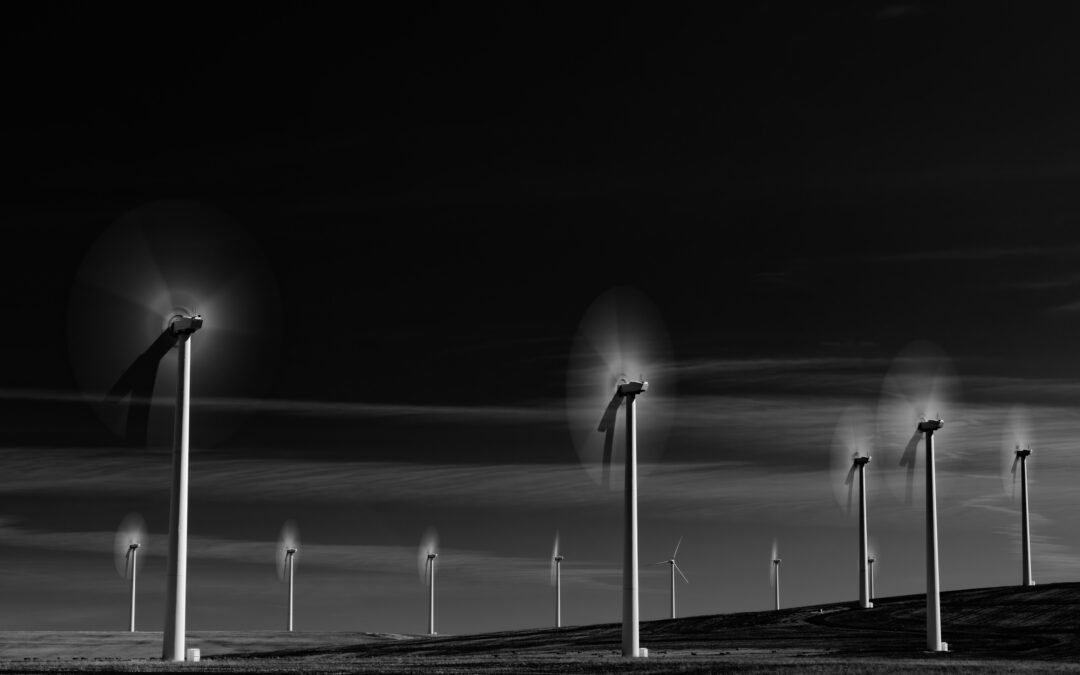
That’s how this photograph of windmills came into being: driving along county roads in central Oregon as I made my way toward John Day, the landscape became an ocean of rolling wheat fields where windmills dotted the horizon like a fleet of ships’ masts on the high seas. My creative eye was intrigued—how to best capture a unique perspective of this scene? Finally, I found the right spot: parking the truck & trailer, I grabbed my gear and spent the next 20 minutes working with the angled afternoon sun and various Neutral Density filters to slow my shutter speed enough to achieve that motion effect in the moving blades.
Of course this image has nothing to do with the Painted Hills—and that’s the point. This was pure serendipity: a place I stumbled upon where scene, subject, and light beckoned me. This is what I mean by being in the moment: enjoying the journey itself, and being open to discovering unexpected opportunities. My best works come from finding that balance between the practical and the creative.
About this Artwork
Entitled, Windmills of the Wandering Eye, this photograph is a dramatic view of a windmill farm in eastern Washington state.
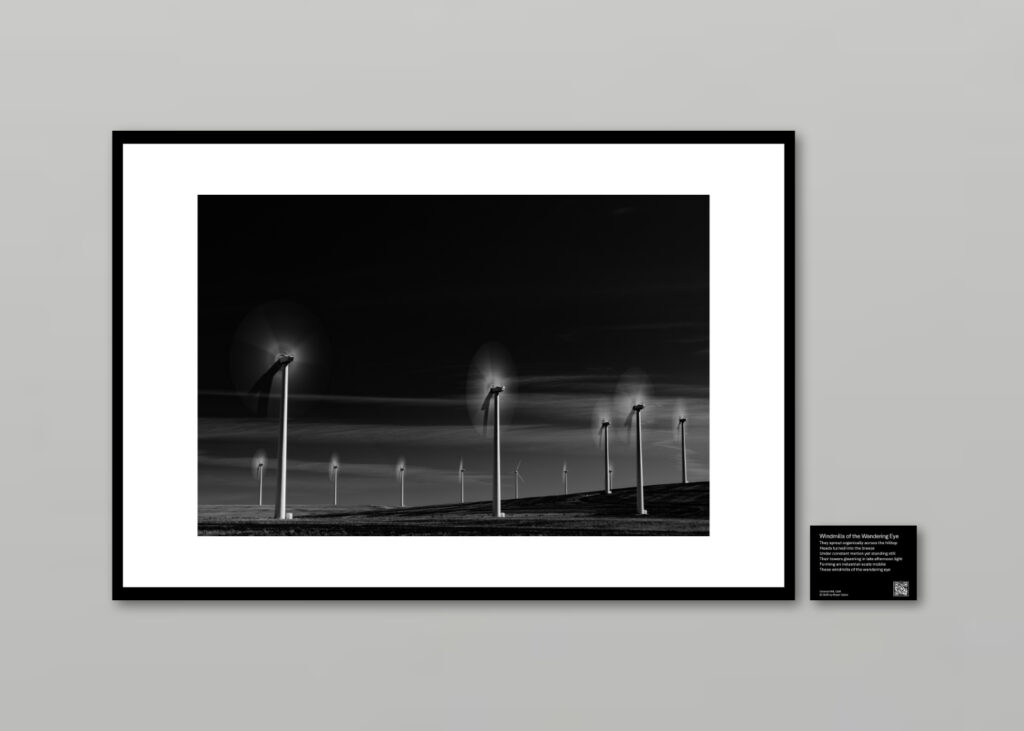
The work is available as a limited-edition framed print. Its accompanying narrative is etched into a black acrylic plaque, designed to be hung next to the print, as shown in the following illustration.
Click the image below to visit this piece’s detail page where you can read its narrative, check availability and pricing, and more.
Click to visit this artwork’s detail page in my portfolio.